1kW vs 3kW vs 6kW vs 12kW Gantry Laser Cutting Machine: Which Is Right?
Key takeaways
- The 1kW is applicable to thin sheets, the 3kW is suitable for most general fabrication, the 6kW is for thicker plate, and the 12kW is available for heavy industrial output.
- Size your machine to service 80% of your business - not your heaviest, rarest order.
- Often more important than the headliner wattage are sample cuts, frame rigidity, and after-sales service.
- These costs can exceed the cost of the equipment over the five-year period: Gas, power, consumables, and downtime.
What is a gantry laser cutting machine, and how does it work?
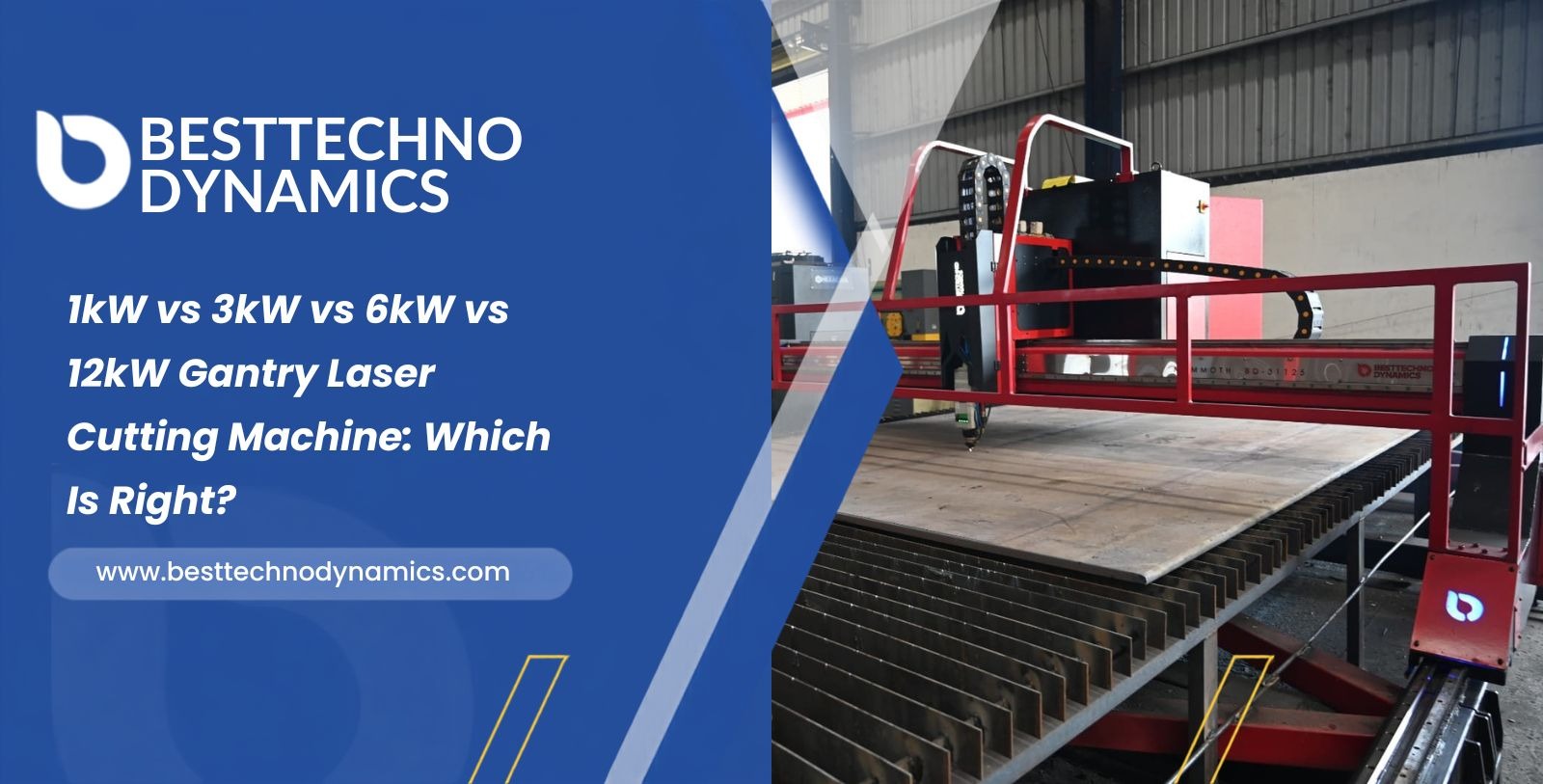
The gantry laser cutting machine is a fiber laser cutting machine installed on a gantry frame that moves along the X and Y axes on a flat cutting bed. The gantry is used to move the cutting head, so it can cut large sheets with high precision and at the same speed. Currently, the majority of modern machines are designed for efficient and low-maintenance metal cutting by fiber lasers.
What makes this category unique, apart from smaller desktop versions, is the gantry design. The frame covers the whole width of the bed so that the cutting head moves over the entire surface of a large sheet of material. This is significant in signage, metal fabrication, automotive and industrial parts manufacturing, where dimensional accuracy needs to be maintained over a long cut. A Gantry Type Laser Cutting Machine manufacturer in India is sought by many customers who require a machine that has reached capability combined with service support in India.
This system is linked together by its constituent parts. Your design file is sent to the CNC controller, which turns your design into instructions for your machine to move. The drive system is used to drive the gantry, and the laser source is used to transmit the laser energy to the laser cutting head that focuses the energy on the material. A stream of assist gas, typically nitrogen, oxygen, or compressed air, is fed into the molten material that is ejected from the cut.
Core components of a gantry system
- Focus: Focuses the beam, and the power rating of the laser (1kW to 12kW) determines the cutting power.
- Cutting head: Concentrates the beam and adjusts the nozzle level to get even cuts.
- Gantry bridge: Supports the head over the bed and remains fixed to ensure precision cuts.
- Drive and motion system: Speed and positioning accuracy are determined by servo motors and linear guides.
- CNC controller and software: Reads design files, nesting, and processes the cutting program.
- Cutting Bed and Extraction: Removes smoke and fumes from the cutting process while holding down the sheet.
Moreover, knowing the components allows you to make a real comparison of machines and not just by the number of watts on the headline. A high-power laser on a weak frame or poor motion system will not give you the accuracy you are looking for.
How does laser power change cutting performance?
The thickness and the cutting speed of the machine are determined by the power of the laser. The greater the wattage, the more power it can deliver to the cutting area, allowing for increased material removal rates and cutting thicker material at higher speeds. Lower-powered machines are still accurate on thin material but become significantly slower on thicker materials.
But there's more to it than that. Assist gas, nozzle condition, beam quality, and material grade are all factors that affect cut quality. The table below is approximate and is for mild steel, which is the most frequently used material in fabrication. Always check the true capacity from the manufacturer when using a particular material.
| Laser Power | Approx. Max Thickness (Mild Steel) | Best Use | Speed on Thin Sheet | Ideal Buyer |
|---|---|---|---|---|
| 1kW | Up to about 6 mm | Thin sheet, signage, light fabrication | Moderate | Startups, sign shops |
| 3kW | Up to about 12 mm | General fabrication, mixed materials | High | Job shops, small manufacturers |
| 6kW | Up to about 20 mm | Structural parts, heavier fabrication | Very high | Growing manufacturers |
| 12kW | 25 mm and above | Heavy plate, high-volume production | Highest | Large industrial unit |
1kW: Best for Thin Sheets and Light Jobs
The 1kW machine is a good choice for stainless steel, mild steel and up to a few millimetres of aluminium. It leaves clean edges on very thin material, and is useful for decorative panels, signboards and enclosures. It is also a logical starting point for a new workshop due to its lower running load.
The compromise is speed for thicker material. If you have a full order book, it takes much longer to get through a product if you are cutting close to your upper limit. However, a 1kW system may be the most cost-effective option if the work is thin.
3kW: The Practical All-Rounder
For general fabrication workshops, a 3kW machine is the most popular one. It is able to cut mild steel, stainless steel, and aluminium at a decent speed over a broad thickness range. Many job shops select this power since it allows them to process the majority of their daily workload without paying for power that they will not use often.
The greatest virtue of it is its flexibility. One machine can process thin sheet for brackets and enclosures, as well as moderate-thickness machine and equipment components. A 3kW system is considered ideal for most small to mid-size businesses because of the balance of cost, efficiency, and flexibility.
6kW: For Thicker Plate and Faster Throughput
A 6kW system results in a very noticeable reduction in thickness of plate and has a much quicker run rate on mid-range material. This is a good choice for manufacturers making structural components, frames, and heavier fabricated parts. The faster the cutting speed, the shorter the lead time, the better it is for customers who require quick turnaround.
Therefore, this machine is more expensive to buy and operate and requires steady work in order to be justified. Long idle times add up in terms of capital waste. Before choosing this power level, work out the thickness mix of the product per month.
12kW: Built for Heavy Industrial Output
The 12kW machine is designed for high volume plate cutting and heavy-duty applications. It is capable of handling thick steel faster than the smaller machines, which is ideal for large industrial units, shipbuilding suppliers, and companies operating on multiple shifts. This is a significant gain in productivity, if the task is worth it.
This type of system requires additional resources from your facility. Power, cooling, extraction, and floor space will be required, along with operators. A 12kW machine is a costly answer to a problem that the company doesn't have, especially for companies that cut thin material.
Which laser power is right for your business?
The right power for your laser is the one you use most often – not the biggest you can afford! First, identify the materials, thicknesses, and daily volume of cuts that you are cutting right now, and then consider what you want to cut in the next two to three years, being realistic. This not only allows for underpowering but also overspending.
Many buyers make the error of purchasing for the extreme work they hope to obtain. The better way is to arrange 80% of your normal work and use the rare heavy work as a way to outsource. This ensures your investment is in sync with real income.
Factors to weigh before you decide
- Material type: Stainless steel, mild steel, and aluminium cut differently and require different power and gas settings.
- Thickness range: Your most common thickness matters more than your single thickest job.
- High: Continuous production, higher power, more cutting.
- Budget: Consider the full cost, including gas, consumables, power, and maintenance, not just the purchase price.
- Power supply and floor space: Make sure your power supply and floor space will support the machine.
- Growth plans: If you think you'll be adding more weight in the near future, it might be worth going with a slightly higher power.
How should you evaluate a machine before buying?
A structured evaluation will shield you from making a selection based on price and specification sheets. Use these tips to determine which options perform best and provide more long-term value.
- Determine material and thickness combinations: Record the name of the 3-5 most frequently cut materials and thicknesses.
- Estimate your daily running hours: The laser and cooling system will be required to operate differently depending on how often it is used.
- Shortlist manufacturers and request quotes: Request written specifications, such as bed dimensions, positioning accuracy, and warranties.
- Take samples of materials: Check the edge quality, kerf width and dimensional accuracy by self.
- Check after-sales support: Ensure the installation, training, spares, and response time for service calls are confirmed.
- Compare total cost of ownership: Include Gas, Consumables, Electricity, Maintenance Contracts, and downtime over 5 years.
Furthermore, cheaper in theory can be more expensive in reality if consumption is higher, servicing is required more often, or if spare parts are not readily available locally. Request references from suppliers from customers who have a similar project and, if possible, go to a running installation.
Where should you buy your machine in India?
In India, there are numerous suppliers, and the key is to select one that offers a good quality product, is service-oriented, and is transparent. Check machine demonstrations, part sourcing transparency, and training and installation commitments with the manufacturer. It's important that local support is available, since downtime is costly, and that technicians and spares are easily accessible to keep your production schedule uninterrupted.
Gujarat is one of the best industrial bases in the country and has a variety of engineering and fabrication clusters. When looking for laser cutting machine manufacturers in Gujarat, buyers frequently look for manufacturers with a robust local network that can streamline logistics and after-sales service. However, location should not be a substitute for technical analysis. A supplier that is close by but has weak machines is not a good choice, whereas a supplier further away that has strong service and has proven builds may be a better supplier.
When comparing suppliers, inquire about the frame construction, the type of laser source, the warranty period, and the supplier's spare part stock. Ask to tour the facility or see it in action. A good supplier will be able to demonstrate to you that the machine is capable of working on your material, which should give you the best indication of confidence in their product.
Conclusion
A single laser power isn't ideal for each business. For a sign shop, a 1kW system may be the best deal, but for a heavy plate manufacturer, a 12kW system might be necessary. You just need to establish your materials, thickness range, daily volume, and growth plans, and the decision becomes easy. Narrow down your choices with the help of the comparison table, the evaluation steps, and the buying factors found within this guide.
As soon as you're ready to compare suppliers, seek out a manufacturer of Gantry Type laser machine manufacturers in India that provides sample cutting, clear specifications, and reliable support. If you are from Gujarat or any other part of the world, make sure you focus on what has worked for them rather than what they have promised you. Besttechno Dynamics can serve you to determine the appropriate gantry laser cutting machine for your materials and production requirements.
Frequently Asked Questions
1. Which laser power is best for a small workshop?
Typically, a 1kW or 3kW machine is sufficient for a small workshop, depending on the thickness of the materials and the number of jobs carried out on a daily basis.
2. Can a 3kW laser cut stainless steel?
Yes, a 3kW machine can cut stainless steel, especially medium-thickness stainless steel, in a clean cut, with the help of nitrogen cutting assistance.
3. How much floor space does a gantry laser machine need?
Bed sizes will determine space requirements; include space required for loading, handling, and maintenance access.
4. What after-sales support should I expect?
There are many laser machine manufacturers in India who are established and have facilities to install the lasers, train the operators, and provide spare parts support; inquire about the terms of the service.